%20(1)_edited.png)


From Stereotypes to Strategy: End Hispandering Through Cultural Insight

January 31, 2026
By: Maya Shah

Courtesy of Unsplash, Edited by Maya Shah
If a brand’s only nod to Hispanic consumers happens during Hispanic Heritage Month, it’s not inclusion, it’s convenience. Extra points if the campaign slaps random Spanish words in the copy (bonus if it features familia, cultura, or fiesta) and some little graphics of only Mexican dishes or attire (sombreros, tacos, guac, we get it). There are more than 65 million Hispanics in the U.S. coming from 20 unique countries, but you wouldn’t know it from how brands continue to market to the community, even during the month they want to spotlight the segment.
Hispandering is when brands employ a one-size-fits-all approach for all U.S. Hispanic consumers, which makes many Hispanic-targeted ads feel flat, forced, surface-level, and based on stereotypes instead of true values. The concept originates from Hispanic marketing thought leadership that emerged in response to political campaigns and brand efforts that relied on clichés rather than cultural understanding. Ads built on Hispandering fail to capture an audience with over $2.7 trillion in buying power. More research and care behind campaigns could bridge this gap and express a true understanding of the segments' needs, values, and motivators to benefit consumers and the brand alike.
Redundancy, Tokenism, and Lost Trust From Latinos
Despite making up almost 20% of the U.S. population, many marketers treat Hispanic markets as colorful, fun, fiesta-loving “others” that will resonate with the same graphics and copy year after year. No one is moved by seeing a piñata on a billboard for jeans during Hispanic Heritage Month. In these cases, it is more worthwhile to shelf a Hispanic-centered campaign than to run a hasty one that runs for one month and harms the relationship. Poorly researched campaigns do nothing but waste the marketing budget and cause eye rolls among the community they want to serve. If the brand feels its own team is not equipped to create and implement the campaign with its own research and perspectives, there are numerous advertising agencies with a sole dedication to Hispanic marketing that can be consulted.
Brands that fall into the Hispandering realm can face heavy backlash and offend the communities they are trying to show love to, in some cases. While these errors are not made from malice, they do demonstrate a lack of planning, diligence, and Hispanic voices working behind the campaign. Seeing the contrast side by side, the contrast is clear in which brands handled their Hispanic consumers with them at the forefront of their strategy, versus pushing out something vaguely Hispanic-adjacent.
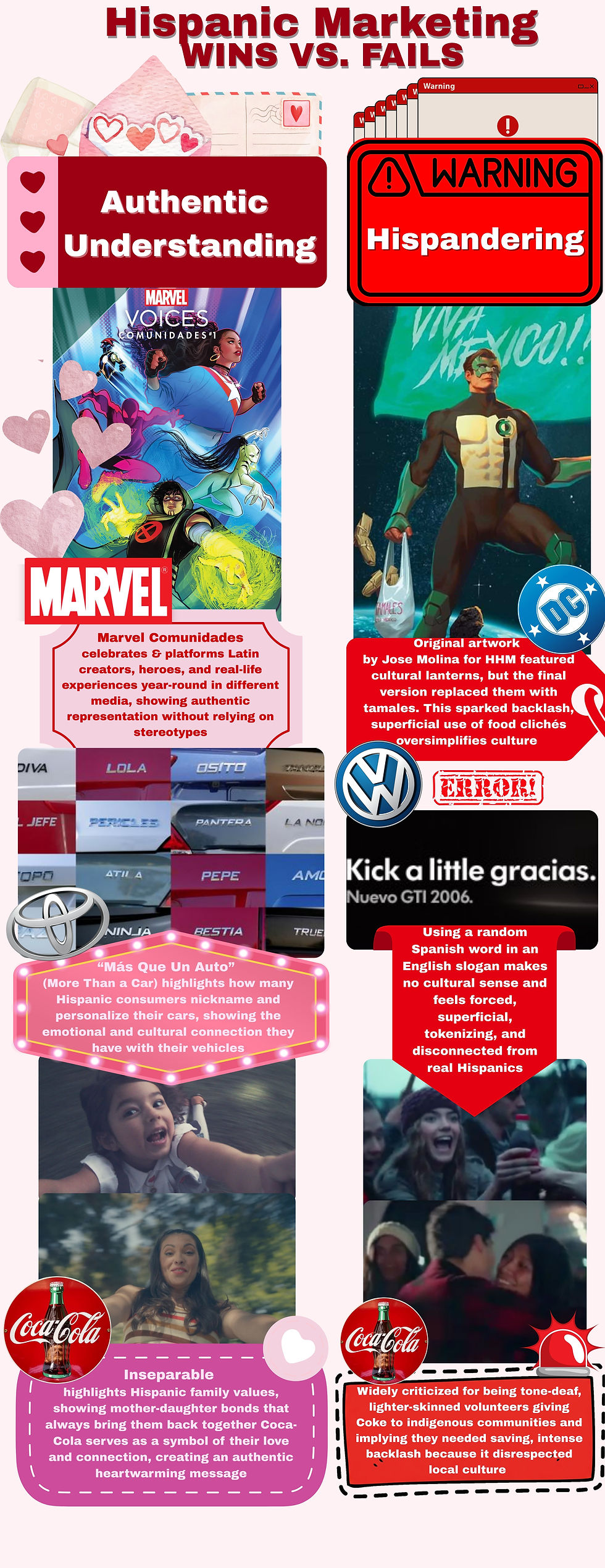
Infographic by Maya Shah
In Hispanic Culture, Community Leads

Courtesy of Jack via Unsplash
64% of Hispanic consumers seek brands that express a genuine understanding of the Hispanic experience, which can increase brand loyalty, brand salience, and buzz. While each nation has its own unique culture, cuisine, and slang, some overarching values can move Hispanic campaigns forward. One of the largest differences between the general American market and Hispanic markets is their skew towards individualism or collectivism. American consumers tend to be highly individualistic, prioritizing their own comfort, independence, and achievements. Hispanic consumers are highly collectivistic, keeping in mind family and friends in almost any purchase. Ads with imagery of people succeeding or enjoying the firm's offerings alone will not resonate as well as more communal-oriented imagery. It is these readily available insights that can transform a campaign from a miss to a hit.
An example, according to Hispanic Marketing: The Evolution of Latino Consumers, is that Hispanic consumers are not swayed as much by campaigns featuring material wealth, as opposed to enjoyment of life among loved ones, many viewing opulent, eccentric displays of wealth as a bit distasteful. This contrasts with the general market, where many ads focus on getting rich and showing off with expensive items; an ad featuring these themes would not be as effective on Hispanic communities. Human connection, protecting family, and messaging aligning with aspirational growth, stability, community, and trust are stronger motivators that can elicit purchase. Life and love are worth celebrating, enjoy today because tomorrow is not promised, and strong familial bonds are pillars of the culture and what steer the community.
When approaching the Hispanic market as a whole, there is readily available data, stats, and experiential data that firms can intertwine their campaign objectives with, creating a new dimension for the brand's image or specific product, while also demonstrating true commitment to meeting their needs.
Segmenting the Segment: Acculturation & Language

Courtesy of Manuel Figueroa via Unsplash
The way we are introduced to language helps shape our realities and how we interact with advertising. The way we are introduced to language shapes how we see the world and how we engage with advertising. My grandmother was born and raised in Colombia and immigrated to the U.S. as an adult, so she feels most comfortable speaking and consuming media in Spanish. My mom immigrated as a child and grew up bilingual, naturally moving between Spanish and English depending on context. I was born in the U.S. and learned English first, picking up Spanish later through family, media, and school. While a marketer might group us as three women from the same Hispanic family, language and acculturation place us in distinctly different segments that influence how we interpret and emotionally respond to the same message.
From a segmentation lens, we fall into Hispanic-Dominant, Bilingual, and English-Dominant groups, while acculturation further distinguishes us as Hispanic-Dominant, Bicultural, and New Identity consumers. These differences shape more than comprehension; they affect trust, cultural resonance, and brand relevance. When brands overlook these nuances, they flatten a complex audience into a single message that only resonates with a stale stereotype of what Hispanic consumers are perceived to be.
With each different segment, there are their own technology usages, different media that will generate more reach, and different copy that has to be employed, even though we all have the same familial background. Firms that want to truly dominate the market share for Hispanic people should keep this in mind and adjust based on their target market's demographics.
Moving Beyond Hispandering
Hispandering is outdated and easy to see through. The segment has higher buy rates, more shopping occasions, and contributes 23% to dollar growth. The population and buying power are growing every day, and brand loyalty can be passed down generation to generation (hello Vicks VapoRub). When trying to enter this market, the approach is everything. Cultural nuance in campaigns can skyrocket brands when the consumer's unique values, background, and motivators are understood fluently. To win the love of Hispanic consumers, brands must move beyond performative moments and invest in culturally nuanced strategies informed by real insight, not just the calendar. When brands lead with a real understanding of values, motivations, and lived experiences, cultural relevance stops feeling risky and starts becoming a clear way to grow the core audience. Hispandering doesn’t just fail, it costs brands the trust and loyalty they could have built for decades.
Maya Shah is a current Master of Science student in Integrated Marketing Communications. She loves pop culture, good food, and all types of music.


Comments